
Five Hundred Card Game Rules
Five Hundred is a card game for 3-5 players. A round typically takes 30-60 minutes, and the recommended age is 10+.
Rules for the card game Five Hundred: Bid tricks and trumps, swap with the kitty, and be the first side to reach 500 points.
This page covers the Australian trick-taking game Five Hundred, not the rummy game 500 Rummy.
About the game
Five Hundred is a trick-taking game for four players in two fixed partnerships, with partners sitting opposite each other. It is the national card game of Australia and a relative of both Euchre and Bridge. You bid how many tricks your side will take and which suit will be trumps, and then you try to deliver what you promised.
The aim is to be the first side to reach 500 points, which is where the game gets its name. A hand comes in three parts: the bidding, the exchange with the kitty (three hidden cards on the table), and ten tricks. The bidding and the two bower jacks take a little learning, but once they click, this is one of the most rewarding partnership card games around.
What you need
Five Hundred uses its own 43-card pack. You build it easily from an ordinary deck: take out all the 2s and 3s, and the two black 4s (the 4 of spades and the 4 of clubs). Then add one joker. That leaves you with 43 cards.
This means the red suits (hearts and diamonds) run from ace down to the 4, while the black suits (spades and clubs) only go down to the 5. The joker is often called the bird, because in Australian Five Hundred packs it shows a laughing kookaburra rather than a jester. You also need paper and a pencil for keeping score.
Card ranking
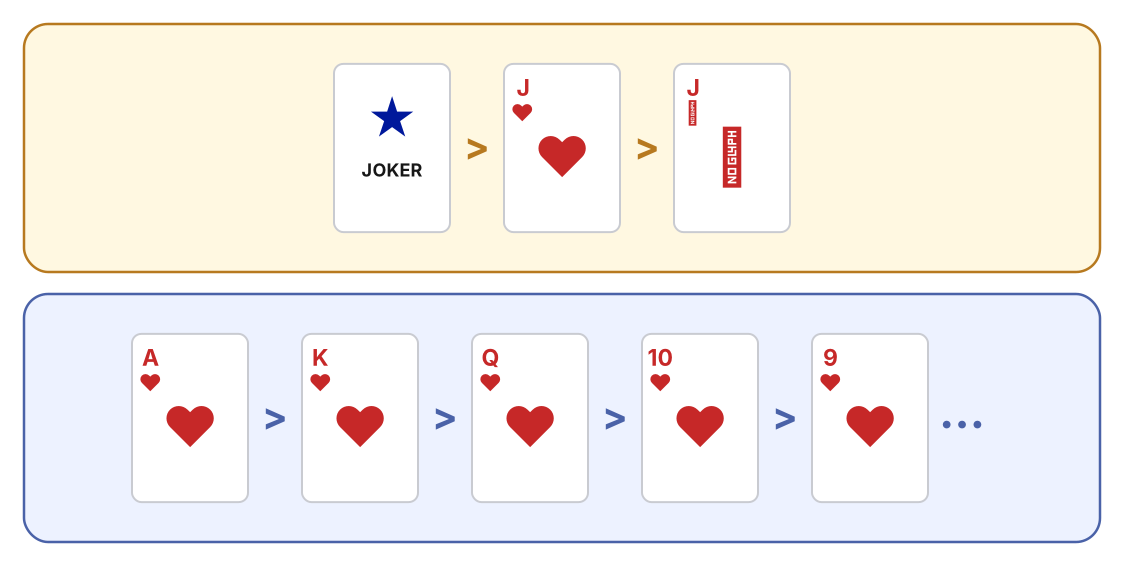
When a suit is trumps, the jacks change their place. The highest trump is always the joker. Next comes the jack of the trump suit, called the right bower, and then the jack of the other suit of the same colour, called the left bower. The left bower counts as a trump for the rest of the hand.
For example, with hearts as trumps the order from the top is joker, then the jack of hearts (right bower), then the jack of diamonds (left bower), then the ace, king, queen, 10, 9 of hearts and so on down. Diamonds lose their jack to the trump suit, so plain diamonds run ace, king, queen, 10 and down with no jack.
The other suits rank normally, from the ace (high) down to the 5 or the 4 (low). With no trumps (a grand bid) every suit ranks in the usual way from ace to bottom, and the joker is the only trump, with its own rules for how it may be played.
Dealing and the kitty
The dealer gives ten cards to each player. Three more are placed face down in the middle and called the kitty (also the widow). A common rhythm is three cards to each player, one to the kitty, four cards to each, one to the kitty, three cards to each, and the last one to the kitty.
The kitty matters a great deal: whoever wins the bidding gets to pick up these three cards and swaps them for three cards from their hand. So the high bidder chooses three extra cards to strengthen the hand they will play.
Bidding
Bidding starts to the dealer's left and goes clockwise. You can bid a number of tricks (at least six) and a trump suit, for instance eight diamonds, which promises that your side will take at least eight tricks with diamonds as trumps. You can also bid a number with no trumps (a grand), or pass.
Each new bid must be higher than the last, either more tricks or the same number in a higher suit. For bidding, the suits rank from lowest to highest like this: spades, clubs, diamonds, hearts, no trumps. So the lowest possible bid is six spades and the highest is ten no trumps. If all four players pass, the cards are thrown in and dealt again.
There are two special bids. Misère is a promise to lose every trick, played alone while your partner sets their cards aside. Open misère is the same, except your hand is laid face up on the table after the first trick. Misère can only be bid once someone has bid seven, and it ranks between seven and eight in value.
The bid table
Each bid is worth a fixed number of points, following the table below (known as the Avondale schedule). A grand is worth most, spades least.
| Tricks | Spades | Clubs | Diamonds | Hearts | Grand |
| 6 | 40 | 60 | 80 | 100 | 120 |
| 7 | 140 | 160 | 180 | 200 | 220 |
| 8 | 240 | 260 | 280 | 300 | 320 |
| 9 | 340 | 360 | 380 | 400 | 420 |
| 10 | 440 | 460 | 480 | 500 | 520 |
Misère is worth 250 points and open misère 500. A bid of ten hearts is worth exactly 500, so a single bid brought home can settle the whole game.
Playing the hand
The player who won the bidding first picks up the kitty and puts three cards face down to the side. That same player then leads to the first trick. Play goes clockwise, and you must follow the suit that was led if you can. If you have no card in that suit, you may play anything, trumps included.
A trick is won by the highest trump in it, or, if no one played a trump, by the highest card of the suit that was led. Whoever wins the trick leads to the next one. You carry on until all ten tricks have been played.
The joker is the highest trump when there is a trump suit. In a grand or a misère, the joker is the only trump: the bidder may name which suit it belongs to before the first trick, or else it counts as the highest card of no suit and can only be played when you are void in the suit that was led.
Scoring
After the hand you settle up. If the bidding side takes at least the number of tricks it promised, it scores the value from the table. The opponents score 10 points for every trick they took themselves. There is no bonus for tricks beyond the bid, with one exception: if the bidding side wins all ten tricks and the bid was worth less than 250, they score 250 instead.
If the bidding side falls short, the value of the bid is subtracted from their score, which can leave them in the minus. The opponents still score 10 points for each trick they took. In a misère, the bidder loses if they take even a single trick.
The first side to reach 500 points or more wins, but only through a bid they bring home themselves. You cannot win the game on the 10-point trick scores the opponents hand out. If a side drops to minus 500, they have lost the game.
Tips and strategy
Count your trumps before you bid. With the joker, both bowers and a couple of high trumps on top, you are far stronger than the raw number of cards suggests. Remember that the kitty gives you three more cards, so a hand that is nearly there can still make a sound bid.
Do not bid higher than you dare to hold. A failed bid costs you its full value in the minus, and the opponents score on top of that. A grand is valuable, but it wants scattered aces and control in several suits. Misère suits a hand full of low cards from which you can safely duck every trick.
As a partner, read the bidding: when your partner names a suit, it tells you where the strength lies. Lead out your high trumps to draw the opponents' trumps, and keep a small card to throw away when you need to give up a trick.
Variants and house rules
Five Hundred can be played with other numbers of players. With three players you use a 33-card pack (7 up to ace in every suit plus the joker), and each player is on their own. With five players you use a full deck with one joker, and the winner of the bidding picks a partner by calling for a particular card.
The rules around the joker and misère vary from table to table. Some do not allow misère at all, some let it be bid before anyone has bid seven, and some use a 45-card pack where the 4s stay in and the kitty holds five cards. Agree on your version before you start.
If you enjoy trick-taking games, the site has more. Bridge is a close relative of Five Hundred, and 500 Rummy shares the number in its name but plays by completely different rules.
Why is it called Five Hundred?
The name comes from the target: the first side to reach 500 points wins. The number also ties into the bid table, where the highest ordinary suit bid, ten hearts, is worth exactly 500 points. A single big bid brought home can, in theory, decide the game in one hand.
Is Five Hundred the same as 500 Rummy?
No. Five Hundred is the Australian trick-taking game described here, with bidding, trumps and a joker. The game 500 Rummy on this site is a set-collection game in the rummy family, where you lay down groups and sequences to reach 500 points. They share only the number in the name, not the rules.
About this version
These rules describe the Australian four-handed version with two fixed partnerships, a 43-card pack and the Avondale scoring schedule. We cover ordinary suit bids, grands and misère. The three- and five-handed versions are noted briefly at the end.
Do you play with different rules where you live, or did you spot a mistake? Send me an email.
Similar games
Tribello (alias Three-Player Whist, Illinois Whist or Three-Handed Whist)
Trick-taking game where each round has new rules and goals. A tactical game for three players.
Amerikaner (alias The American, Kani or Norwegian Whist Variant)
Trick-taking game where you bid on number of tricks and cooperate with a partner. First to 52 points wins.
Nomination Whist (alias Peasant Bridge, The Ten or Grip)
Trick-taking game where the goal is to take exactly what you bid. Well suited for 2-5 players who like strategy.